
CASE STUDIES
Selected projects where Generative AI and rapid prototyping were used to reduce uncertainty, test assumptions, and support strategic decisions.
Each case shows how abstract questions were translated into tangible evidence—so teams could decide faster, with less risk
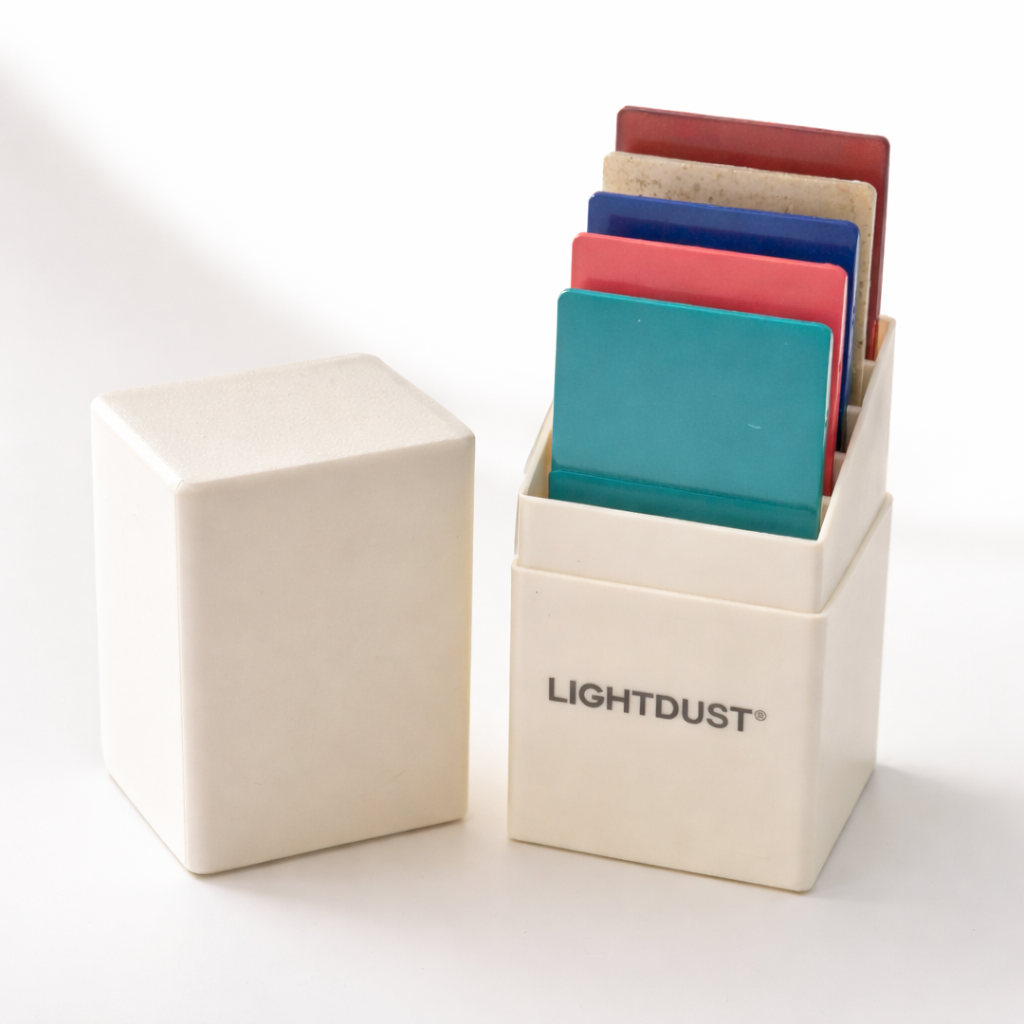
LIGHTDUST PATENT
Lightdust™ – Turning quarry waste into a scalable polymer platform. Enabled the client to validate material viability before capital investment, reducing material risk and unlocking a licensing. A patented composite material that repurposes industrial residue into a durable, adaptable solution for rotational and injection molding applications.

COLOR FITZ
KolorFitz™ – Reducing color risk between material and print. Allowed color decisions under production constraints, aligning internal stakeholders and saving weeks of rework. A structured methodology that enables objective, reproducible color decisions—aligning business, market, and customer perception in complex industrial contexts.

TOY GAMIFICATION
From bubble toy to interactive game system. Demonstrated feasibility of a simplified hardware‑software play system, guiding next stage product planning.
A physical–digital play platform that transforms passive bubble making into measurable, repeatable gameplay across ages and contexts.

LIGHTDUST PATENT
Reframing luxury watch packaging through a mono-material polyethylene architecture. Enabled the exploration of industrial feasibility while reducing end-of-life complexity and material incompatibility risks. A single-polymer packaging system integrating structure, hinge, surface texture and cushioning within one recyclable family.

COLOR FITZ
Persona-Based Concept Validation — Reducing early-stage product risk through narrative positioning.
Enabled the client to test product desirability and positioning before committing to development, reducing market risk and misalignment. A structured approach associating product concepts with defined personas, allowing early validation through visual scenarios and targeted audience feedback.

TOY GAMIFICATION
This study investigated how geometric form influences sensory perception during chocolate tasting, with a focus on organoleptic response rather than visual appeal.